The Global Diagnostic Equity Gap
An Interview with Dr. Philip Angelides
Nearly half of the world’s population, 47%, has little or no access to basic diagnostics, according to a 2021 Lancet Commission report, with the gap widest in low- and middle-income countries and at the primary-care level. For imaging specifically, that can mean the nearest echocardiogram or CT scanner is hours away, if it exists at all.¹

Dr. Philip Angelides, a Hospital Medicine physician with dual board certifications in Internal Medicine and Pediatrics based in Colorado, calls the problem “diagnostic equity”: the gap between what a clinician in a well-resourced hospital in a major city can diagnose in minutes versus what someone in a public hospital a few hours away can diagnose at all.²
Table of Contents
- The Global Diagnostic Equity Gap
- From Policy to the Bedside
- Diagnostic Equity in Practice
- The IM-FAST Curriculum: Built for Adoption, Designed to Scale
- Experience with Kosmos: Supporting Education and Adoption
- On Starting a POCUS Program
- References
- Q&A: The Global Diagnostic Equity Gap: Dr. Philip Angelides
“There is a very expensive, high-resolution MRI machine in a place like Denver,” he explains. “But in a public hospital in Guatemala, getting an echocardiogram can cost two to three hundred dollars and mean a four-hour round trip to another city. For a family that isn’t well off, that can mean months of food.”
That gap is documented outside of his own experience, too. A 2023 scoping review of point-of-care ultrasound in low-resource settings catalogued a widening range of clinical applications and identified artificial intelligence as a potential enabler of broader adoption, alongside persistent barriers in training, maintenance, and on-site image analysis.³
Portability and cost are two variables that make POCUS different from traditional cart-based ultrasound systems, and both matter more as resources get scarcer. These variables help get a system into a hospital in the first place. What determines whether it is still in use two years later, in Dr. Angelides’s experience, is something different: whether the clinicians using it develop a way to fold it into the work they are already doing, and someone locally to champion and continue teaching after the initial training concludes.
Existing evidence points in the same direction. A 2025 scoping review of 53 POCUS-training publications from low- and middle-income countries identified local trainers, continuous supervision, tele-mentoring, early and ongoing evaluation, and adaptation to local needs as best-practice elements of sustainable training.⁴ A 2026 scoping review of POCUS implementation strategies in similar settings reached a compatible conclusion, finding that thorough planning, continuous evaluation, designated program champions, and local ownership distinguished the programs that held up.⁵
From Policy to the Bedside
Dr. Angelides did not start in medicine. He trained first in international relations, with a global health concentration, and spent time working on humanitarian response, including the Ebola outbreak in Sierra Leone over a decade ago.
“There was something always missing in global health policy,” he says. “The people at the table often had a lack of understanding, or hadn’t spent real time with the people they were trying to help.” That observation is what pushed him toward medicine, and eventually toward point-of-care ultrasound as a tool that could make an immediate difference rather than a policy-level one.
“Ultrasound felt like a true leveler,” he says, “something that wasn’t particularly expensive and could make an impact right away.”
Diagnostic Equity in Practice
Here is what that looks like on the ground. In a small public hospital ward in Guatemala, packed with nearly 30 beds, a 20-year-old patient with a chest X-ray that was, in Dr. Angelides’s words, “completely whited out,” sat low on the transfer list. Because she was compensating well and her vital signs looked stable, the system overlooked the hidden severity of her condition.
“Within seconds of putting an ultrasound probe on her chest, you could see she had a massive pericardial effusion,” he recalls. In that region, pericardial effusion and pericarditis are frequently caused by tuberculosis, so the finding immediately changed the clinical picture.
“It wasn’t until we put that probe on her that we could tell the hospital director, this is a person who needs to get to a hospital that can do a pericardiocentesis, and do it right now.”
The scan did not just accelerate one diagnosis. It reordered triage in a system where transfer lists are long and vitals alone do not always reflect how close a patient is to decompensating.
The IM-FAST Curriculum: Built for Adoption, Designed to Scale
Dr. Angelides is careful to separate acquiring a POCUS device from being able to use it well. “It’s one thing to have a shiny new product,” he says. “It’s another thing to be able to use it properly, so you’re not over- or under-calling what you see.”
That thinking led to IM-FAST (Internal Medicine FAST), a curriculum Dr. Angelides developed with colleagues Dr. Carolina Ortiz-Lopez and Dr. Michelle Fleshner, adapted from the emergency medicine eFAST exam for the clinical questions internal medicine physicians actually face on rounds.
The design followed from what he now regards as the real constraint. “The biggest barrier to POCUS adoption isn’t the technology,” he says. “It’s getting clinicians to pick up the probe and use it consistently.”
His experience is consistent with a national survey of Veterans Affairs hospital medicine groups, in which lack of training was the most common barrier to POCUS use, reported by 89% of groups, even as the share of groups with at least one ultrasound machine rose from 29% in 2015 to 71% in 2020.⁶ IM-FAST therefore functions as a clinical implementation pathway rather than a one-time training add-on, designed to make ultrasound approachable, clinically relevant, and easier to integrate into routine care.
Rather than teaching complex quantitative skills like ejection fraction calculation, the curriculum focuses on a narrower, higher-yield skill set: identifying pleural effusions, bladder volume, pneumothorax, and safe pockets for thoracentesis or paracentesis.
In 2026, Dr. Angelides received First Place, Oral Presentations, Innovations at the Society of Hospital Medicine, and the Center for Global Health’s Award for Distinguished Scholarship for a presentation on the IM-FAST work. ²,⁷
IM-FAST is also an exportable model. The same “narrow but clinically relevant” design principle that works for a resident in Colorado works for a physician in rural Guatemala, and for a program trying to build POCUS competency without asking clinicians to master everything at once.
That’s already happening. The model is being adapted across Guatemala, Ghana, Zimbabwe, Peru, and most recently Greece, where Dr. Angelides is helping stand up a new program. Watching it translate across settings that share little else has reinforced his central point: the curriculum travels because it was designed around how clinicians work, not around what a device can do.
The logic is consistent with the Society of Hospital Medicine’s 2019 position statement on point-of-care ultrasound for hospitalists, which treats image acquisition, interpretation, and clinical integration as distinct competency domains and recommends longitudinal training with mentored feedback, periodic competency assessment, quality assurance, and program management rather than ad hoc device adoption.⁸
Experience with Kosmos: Supporting Education and Adoption
Dr. Angelides first encountered the Kosmos ultrasound system from EchoNous at a Society of Hospital Medicine conference and later brought a device to Guatemala for medical education work. Three things stood out.
“The image quality is really superb,” he says. “It’s not too far off from a lot of the cart-based machines I’ve seen.” For a program built around diagnosing rather than just screening, that baseline mattered.
The second was the AI-assisted anatomical labeling. “The AI features were far ahead of some of the other capabilities I’d seen, and they’re available in both English and Spanish,” he says.
In a teaching setting where he knew he would not always be present, real-time labeling of structures like the liver, right ventricle, and left ventricle gave trainees a way to check their own work.
“I think having something like an AI feature that helps with identifying anatomical structures on their own is really huge,” he adds, describing how trainees now send him images over WhatsApp with a tentative read already attached. AI-assisted anatomical labeling, in his account, “helped reinforce learning for clinicians early in their ultrasound journey,” and could “support self-learning long after we left Guatemala.”⁹
The teaching in Guatemala had an end date, so what mattered was whether the group could work without him. Anatomical labeling served that end. It gave trainees scanning on their own a way to verify anatomy, which made the device a study aid as much as a diagnostic one. The clinician still interprets the image. But a trainee with no way to check what they are seeing may lose confidence and stop, and that is what the labeling guards against.
There is early evidence behind that. In a 2025 randomized controlled study of 66 medical students with no prior experience in focused cardiac ultrasound, a one-hour, self-directed Kosmos session combining anatomical labeling, probe-position guidance, and real-time image-quality feedback was noninferior to instructor-led teaching for immediate image acquisition.¹⁰
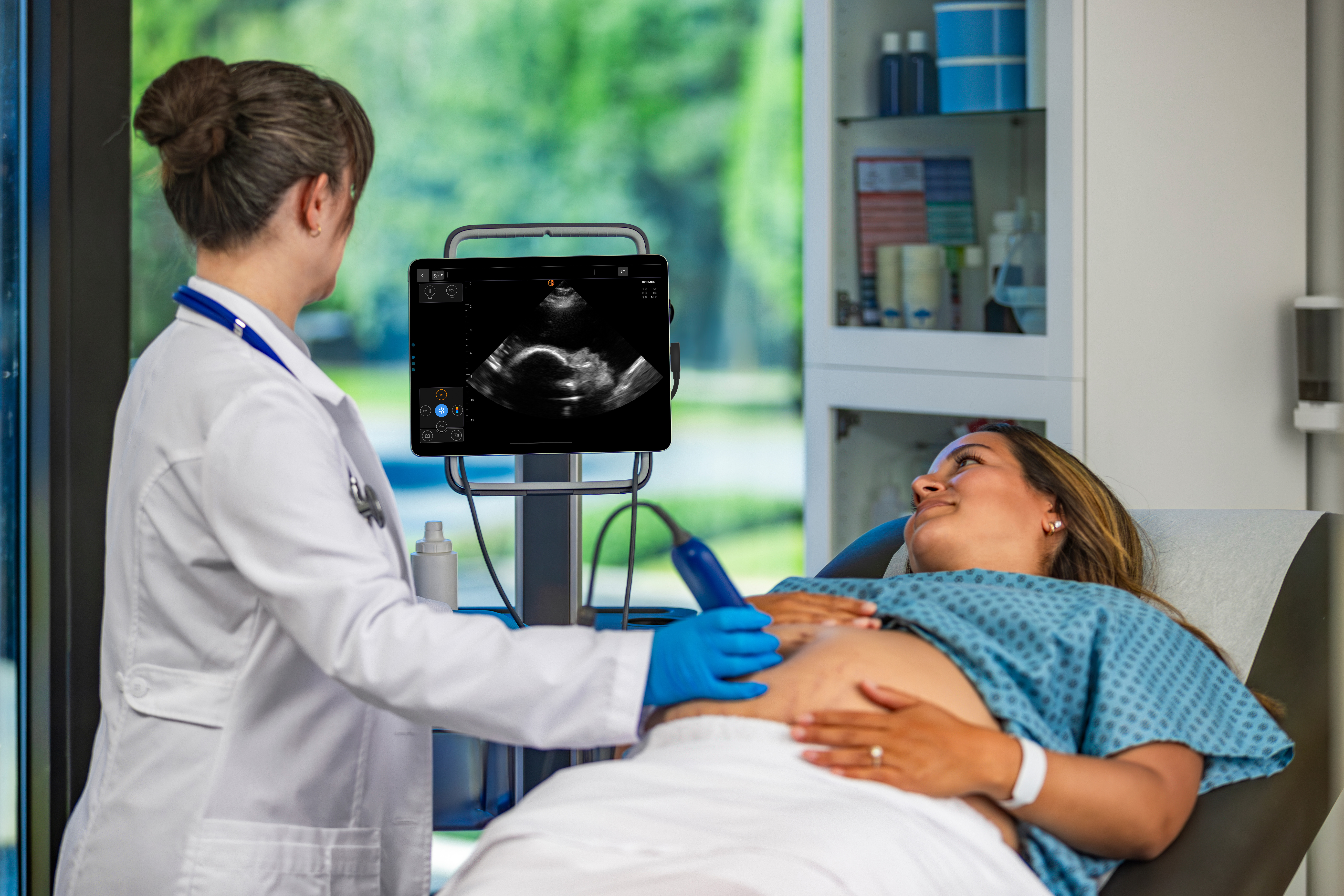
Portability served the same end. In Guatemala it meant the teaching could happen wherever the patients were, on rounds and in the ward, instead of in a classroom scheduled around them. At one grand rounds session, Dr. Angelides plugged the device into a projector, put the probe on himself, and showed an entire room what a normal exam looks like in real time. Being able to carry the system into those settings is what let the education happen where the clinical work was already happening. Portability allows a probe to reach the bedside in a ward holding close to 30 beds.
The third was versatility. “It’s not a system that’s specifically good for just heart and lungs,” he says. Dr. Angelides used the same device for musculoskeletal imaging, abscess evaluation, vascular access, and piloted it in obstetric care, all without switching machines. For a hospital or clinic trying to build one program instead of several, that consolidation could matter as much as any single feature.
That versatility maps onto how his projects have evolved. Across sites, POCUS is now used for cardiopulmonary, procedural, musculoskeletal, and obstetric questions, and increasingly for infectious disease. The goal, in his work in the US and in the programs he is helping build abroad, including Greece, is not several narrow ultrasound efforts running in parallel but one sustainable bedside ultrasound program broad enough to serve all of them. A single point-of-care ultrasound platform capable of covering that range, like Kosmos, is a practical foundation for building it provides a foundation on which a broader implementation strategy can be built.
“The greatest value of technologies like Kosmos comes when they’re paired with an implementation strategy that helps clinicians become confident, independent users,” he says.
On Starting a POCUS Program
Asked what he would tell someone starting a POCUS program anywhere in the world, Dr. Angelides did not start with the device. “Before getting to the device, you need buy-in from the group and the people you’re training,” he says. “Without that internal motivation, it’s hard to start a program anywhere.”
From there, he points to context: a lung-ultrasound-heavy curriculum makes sense where pediatric pneumonia is common, while a vascular access focus fits a setting built around procedural safety.
Time is its own constraint. His colleagues in Guatemala round in the morning and staff outpatient clinics in the afternoon, which leaves little dedicated time for training. The program’s answer was to build teaching into rounds rather than schedule it separately. That is also how Dr. Angelides learned it himself, from an Attending in his residency who used POCUS on the spot to answer a specific clinical question, rather than finishing rounds and ordering a test from a workstation. Fit with existing workflow is now one of the first things he looks for.
And finally, retention. “It’s one thing to do a workshop,” he says. “The more important thing we know about point-of-care ultrasound is the retention aspect.” His own program now runs on WhatsApp groups for image sharing, regular image review sessions, and online modules, longitudinal structure built to outlast the initial training.
Longitudinal feedback of that kind has direct, if short-term, implementation evidence. In one internal-medicine residency global-health track, remote faculty review of 270 POCUS examinations over seven weeks was associated with significant improvement in reviewer-rated image quality and in agreement between trainee and faculty interpretations.¹¹
That longitudinal structure and support also helps move clinicians from learning POCUS to teaching it. The programs that last are the ones that develop the local champions, the clinicians who are able to teach the next cohort after the visiting faculty have returned home. That, more than the initial workshop, is what separates a program still running at six months from one still running at two years.
None of that is specific to Guatemala. It is, in Dr. Angelides’s view, the blueprint for closing the diagnostic equity gap anywhere it shows up: buy-in, local context, teaching built into existing workflow, longitudinal mentorship, and local champions who keep the program going long after the workshop ends.
References
- Fleming, K. A., Horton, S., Wilson, M. L., et al. (2021). The Lancet Commission on diagnostics: transforming access to diagnostics. The Lancet, 398(10315), 1997–2050.
- Angelides, P. Interview with the EchoNous team. Conducted July 1, 2026.
- Venkatayogi, N., Gupta, M., Gupta, A., et al. (2023). From Seeing to Knowing with Artificial Intelligence: A Scoping Review of Point-of-Care Ultrasound in Low-Resource Settings. Applied Sciences, 13(14), Article 8427. https://doi.org/10.3390/app13148427
- Eppel, F., Hunstig, F., Bélard, S., & Kreuels, B. (2025). Concepts for point-of-care ultrasound training in low resource settings: a scoping review. The Ultrasound Journal, 17, Article 24. https://doi.org/10.1186/s13089-025-00427-3
- Banda-Katha, G. W., Kachitosi, T., Mwandumba, H. C., Mwapasa, V., Ngwira, L. G., Kreuels, B., & Rahden, P. (2026). Implementation strategies and economic considerations for point-of-care ultrasound in low- and middle-income countries: A scoping review. PLOS Global Public Health, 6(2), Article e0005852. https://doi.org/10.1371/journal.pgph.0005852
- Williams, J. P., Nathanson, R., LoPresti, C. M., et al. (2022). Current use, training, and barriers in point-of-care ultrasound in hospital medicine: A national survey of VA hospitals. Journal of Hospital Medicine, 17, 601–608. https://doi.org/10.1002/jhm.12911
- Angelides, P. Faculty profile. University of Colorado School of Medicine, Division of Hospital Medicine. Retrieved August 12, 2026, from https://som.cuanschutz.edu/Profiles/Faculty/Profile/40485
- Soni, N. J., Schnobrich, D., Mathews, B. K., et al. (2019). Point-of-care ultrasound for hospitalists: A position statement of the Society of Hospital Medicine. Journal of Hospital Medicine, 14, E1–E6. https://doi.org/10.12788/jhm.3079
- Angelides, P. Written correspondence with the EchoNous team. August 2026.
- Lau, Y. H., Acharyya, S., Wee, C. W. L., et al. (2025). Effectiveness of traditional, artificial intelligence-assisted, and virtual reality training modalities for focused cardiac ultrasound skill acquisition: a randomised controlled study. The Ultrasound Journal, 17, Article 61. https://doi.org/10.1186/s13089-025-00469-7
- Fox, S., Fleshner, M., Flanagan, C., et al. (2020). Developing and evaluating a remote quality assurance system for point-of-care ultrasound for an Internal Medicine residency global health track. POCUS Journal, 5(2), 46–54. https://doi.org/10.24908/pocus.v5i2.14433
Q&A: The Global Diagnostic Equity Gap: Dr. Philip Angelides
As described by Dr. Angelides, diagnostic equity refers to the gap between the diagnostic capabilities available in a well-resourced city hospital compared to a rural public hospital. This concept is supported by a 2021 Lancet Commission report, which found that 47% of the global population has little or no access to basic diagnostics, with the widest gaps at the primary-care level in low- and middle-income countries.
According to a national survey of Veterans Affairs hospital medicine groups, the most common reported barrier to POCUS use is a lack of training. A 2023 scoping review also identified persistent barriers in maintenance and on-site image analysis. In Dr. Angelides’s experience, sustainable use depends heavily on whether clinicians can integrate the device into their existing workflows and whether local champions continue teaching after initial training.
IM-FAST (Internal Medicine FAST) is a training curriculum developed by Dr. Angelides, Dr. Carolina Ortiz-Lopez, and Dr. Michelle Fleshner, adapted from the emergency medicine eFAST exam. Designed as a clinical implementation pathway, it aims to make ultrasound approachable and easier to integrate into routine care by focusing on a narrower, high-yield skill set—such as identifying pleural effusions, bladder volume, pneumothorax, and safe pockets for thoracentesis or paracentesis—rather than complex quantitative skills.
A 2023 scoping review identified artificial intelligence as a potential enabler of broader POCUS adoption. In Dr. Angelides’s educational work with the Kosmos system, he noted that AI-assisted anatomical labeling provided trainees with a way to verify anatomy and check their own work when an instructor was absent, helping to maintain their confidence. Furthermore, a 2025 randomized controlled study of 66 medical students suggested that a self-directed session combining AI anatomical labeling and probe-position guidance was noninferior to instructor-led teaching for immediate image acquisition.
Based on Dr. Angelides’s experience and recent scoping reviews of low- and middle-income countries, foundational elements for a sustainable program include:
Buy-in and Context: Securing internal motivation from the medical group and tailoring the focus to local clinical needs (e.g., pediatric pneumonia vs. procedural safety).
Workflow Integration: Building teaching directly into existing clinical routines, such as morning rounds, rather than treating it as an add-on.
Longitudinal Support: Utilizing continuous evaluation, regular image reviews, and remote faculty mentoring to support retention, which a 2020 study associated with improvements in trainee image quality.
Local Ownership: Developing local champions to take over teaching for future cohorts.