The Best Bladder Scanners in 2026:
Comparison, Reviews, & Buyer’s Guide
Choosing a bladder scanner isn’t as complicated as it first appears, and it’s also not as simple as picking the most familiar brand or lowest price. In practice, the right decision comes down to a handful of tradeoffs: accuracy, ease of use, long-term cost, and whether the device can adapt to the needs of your team over time.
This guide is designed to help you make that decision with clarity. We evaluated six of the most commonly considered bladder scanners in 2026 using six criteria that consistently matter at the bedside. Rather than trying to declare a single “winner” for every situation, we highlight where each device performs best, as well as where it may fall short, so you can match the right tool to your clinical setting.
Disclaimer: This Buyer’s Guide has been produced by EchoNous, Inc., a designer, manufacturer and distributor of the Kosmos Bladder scanner. The information provided in this Buyer’s Guide is for general educational and informational purposes only. Although citations to independent sources are included within this Guide, EchoNous, Inc. makes no representations or warranties of any kind, express or implied, about the completeness, accuracy, or reliability of the information. Any reliance you place on this information is strictly at your own risk. In no event will EchoNous be liable for any loss or damage arising out of, or in connection with, the use of this guide.
In This Guide:
- 6 Factors That Actually Matter
- The 2026 Bladder Scanner Ranking
- Head-to-Head Comparison Table
- Detailed Reviews: 6 Bladder Scanners Evaluated
- Your Setting, Your Answer: Decision Guide by Department
- Buyer Checklist
- Frequently Asked Questions
6 Factors That Actually Matter
Bladder scanner specification sheets are full of claims and numbers, but many of them may have a non-material impact on a final decision. After evaluating dozens of devices across hundreds of clinical settings, the criteria that consistently separate the right purchase from a regrettable one can be broken into six factors. If a device scores well on these six, it will likely perform well at the bedside for your team.

Accuracy.
The measurement that can determine whether a patient gets catheterized or not. Small differences in accuracy can have outsized clinical impact, especially in populations where unnecessary catheterization carries significant CAUTI risk. Look for published data.1
Ease of Use.
How quickly can a new staff member perform a reliable scan? In high-turnover environments, this matters enormously. Onboarding, the amount of time required to complete a measurement (including re-scans), and the consistency of results across operators all contribute to whether a scanner is reliably used or quietly avoided.
Training Required.
Related to ease of use, but distinct: how much structured training is needed before staff can scan independently? And what does that training enable: a single measurement, or a broader clinical toolkit?
Portability.
Weight, form factor, battery life, whether the device can scan while charging. All affect how and where the scanner gets used in practice.
Price and Total Cost of Ownership.
Upfront price is the most visible number, but the real cost includes maintenance, probe replacement, warranty coverage, subscriptions, and the value of multi-use capability. A cheaper device that requires annual maintenance and probe replacements can cost more over five years than a premium platform with no recurring costs.
AI Features.
AI in bladder scanning ranges from basic auto-targeting to real-time guidance and automated volume calculation. The most impactful AI features seek to improve scan quality and reduce operator dependence, not just speed up measurement.
The 2026 Bladder Scanner Ranking
A note on evidence: where peer-reviewed clinical data is available, we cite it directly. Where it is not, we rely on manufacturer-reported specifications, FDA-cleared labeling, or published validation studies. Each device review indicates which type of evidence supports the figures shown.
When you apply these six factors to six of the most commonly evaluated bladder scanners, a pattern emerges. There is a top tier, a solid middle, and a group of devices that clinical buyers should think carefully about before purchasing.
- Kosmos® Bladder by EchoNous. Highest published accuracy (±3% in volume-accuracy validation, r=0.988 in a clinical study), solid-state probe, 5-year warranty, and the ability to expand into vascular access and full POCUS. No subscription fees. Most complete fit across selected criteria.2,3,4
- Verathon BladderScan i10. An established vendor with a broad market share in standalone bladder scanners. Short training time, consistent performance, and established GPO relationships. Limited to bladder-only, mechanical probe requires maintenance, ±7.5mL accuracy below 100mL and ±7.5% accuracy above 100mL. Contraindicated for use on fetal patients, pregnant patients, patients with open skin or wounds in the suprapubic region or patients with ascites.5
- Butterfly iQ3 (Bladder AI Mode). This multi-purpose option delivers full point-of-care ultrasound (POCUS) capability. Bladder AI mode available, requires an annual subscription beyond initial purchase. Some users have reported battery duration concerns.6 Butterfly Auto Bladder Volume is specified for adult-only use and contraindicated for fetal/pediatric use, pregnancy, ascites, and open suprapubic skin/wounds. Accuracy calculated on phantom ±7.5 mL / ±7.5% over calibrated phantom volumes 21.6–726.4 mL, and human-subject specification <30 mL / <30% over 15 adult subjects with voided volumes 24.6–514.8 mL. Three-year warranty.7
- BioCon-900 (Laborie). Adequate dedicated scanner with basic automation. Uses a “wobbler” mechanical probe which has moving parts unlike a solid-state design. Range 0-999 ml; accuracy ± 15%, ± 15ml. A single-purpose, bladder-only device: automation is limited to basic volume measurement, with no path to other clinical applications such as vascular access or full POCUS.8
- Clarius Bladder AI with C3 HD3 or PA HD3 Transducers. Portable ultrasound with semi-automatic bladder measurement. Published limits of agreement (-25.45 to +20.83 mL for 0-100 mL volume, up to -91.70 to +60.50 mL for 200-400 mL volume) and no guarantee of accuracy under 70 mL and over 400 mL may limit its use as a primary bladder scanner. 45 – 75 minute battery life. Wireless communication is susceptible to radio frequency interference and severe weather conditions. Requires users to have prior ultrasound training and to utilize clinical judgment to verify measurements, making it better suited as a general diagnostic tool rather than a fully automated nursing scanner.9
- BD (Becton, Dickinson) BBS Revolution. Bladder-only device with no POCUS expansion path. Published accuracy is ±12.5% + 12.5 mL, the lowest among the systems compared.¹⁰ In one FDA adverse event report (MAUDE database), a scan read 568 mL versus 1,200 mL on catheterization, and the reporting facility noted “continued issues with this device” and difficulty of use.¹¹
Bladder Scanner Comparison Table: Accuracy, Cost, and Features
To support an evidence-based evaluation, this matrix compares published specifications that likely have an impact on patient care. This side-by-side data on accuracy, AI capabilities, and clinical limitations may be useful in optimizing your facility’s bedside workflow and CAUTI prevention protocols.
Figure 1a: Bladder Scanner Comparison Table
| Device | Accuracy | Ease of use | Training | AI Features |
|---|---|---|---|---|
Kosmos Bladder by EchoNous2,3,4 | ±3% (r=0.988, clinical performance testing) | Two pathways for accuracy, touchscreen workflow, automatic measurement | 1–2 hrs for bladder; days for full platform | Auto bladder volume, expandable AI applications |
Verathon BladderScan i105 | ±7.5% on volumes >100 mL | 2-button operation | Minutes | ImageSense auto-targeting; Vmode 3D imaging |
Butterfly iQ3 (Bladder AI)6 | ±7.5% est.; not validated >740 mL | Smartphone/tablet app; single probe with presets | 1–2 hrs | Bladder AI mode (subscription required) |
BioCon-900 (Laborie)7 | 0–999 mL; ±15%, ±15 mL | Dedicated scanner with aim-assist | Minimal | Basic auto-aim |
Clarius8 | ±20 mL / ±90 mL | Requires prior ultrasound training; manual measurement verification | Hours to days | Basic measurement tools |
BD (Becton, Dickinson)9 | ±12.5% + 12.5 mL on on tissue equivalent bladder phantom | Dedicated scanner; button-driven operation | Minimal | None |
Figure 1b: Bladder Scanner Comparison Table
| Device | Portability | Key Limitations |
|---|---|---|
Kosmos Bladder by EchoNous2,3,4 | Handheld probe + tablet; scan while charging; flexible cart/ tabletop | May require different onboarding than dedicated scanners |
Verathon BladderScan i105 | 10.1″ touchscreen console + tethered probe; cannot scan while charging | Bladder only; mechanical probe; contraindicated in pregnancy / fetal patient/ open suprapubic wounds / ascites |
Butterfly iQ3 (Bladder AI)6 | Handheld; ~2.5 hr battery life | Subscription required; battery life; accuracy ceiling at 740 mL |
BioCon-900 (Laborie)7 | Portable console + tethered probe | “Wobbler” mechanical probe; limited automation |
Clarius8 | Handheld wireless; ~1 hr battery | Adult use only, trained/qualified users only, clinician responsible for final measurement |
BD (Becton, Dickinson)9 | Portable console + probe | Lowest reported accuracy compared to other 5 devices reviewed; rotational motor probe; FDA Adverse Event Report |
Switching Considerations
Most teams don’t just compare features, they ask how hard it will be to actually switch. The transition from one bladder scanner to another, or from a dedicated scanner to a multi-purpose POCUS platform, is rarely as disruptive as buyers expect, but the right answer depends on what is being replaced and what is being adopted.
Training time scales with capability. Dedicated bladder scanners are designed around a single, narrow workflow: place the probe, press a button, read the volume. Manufacturers including Verathon claim minutes-to-competency for the i10, which is reasonable in practice for staff who only need bladder volume measurement. Multi-purpose platforms require more upfront investment to train up staff in multiple applications. For nursing teams that will only ever scan bladders, additional curriculum may not be necessary. For teams expanding into vascular access or broader POCUS, it is an investment that could pay compound returns.
Workflow impact depends on volume and use case. A well-implemented bladder-scan protocol: standardized, documented, and consistently applied across shifts, reduces unnecessary catheterization and the downstream CAUTI risk that comes with it.1 The savings come from accurate bladder-volume measurements before catheterization decisions are made, which means the workflow needs consistent scanning across the full team. The right question for a switch is not “will it be faster?”, rather, it is “will the measurements be more reliable across the full nursing team?”
Staff adoption favors familiarity short-term, capability long-term. Teams that have used the same scanner for years may prefer a familiar workflow, and that preference is worth respecting. Institutions planning a transition typically address it the same way: identify clinical champions, protect practice time during the first weeks of use, and lay out a structured plan for layering in additional capability like vascular access once the core bladder workflow is stable. Whether that broader capability is worth the transition cost depends on the department’s appetite for an expanding POCUS footprint.
Hidden costs are usually larger than the headline price. Upfront device cost is the easy number to compare. The harder numbers are recurring: subscription fees, preventive-maintenance contracts on mechanical wobbler or rotational probes, probe replacements as moving parts wear, training time for high-turnover units, and warranty exclusions for consumables and accessory damage. The five-year total cost of ownership for a moderately priced scanner with annual subscription, maintenance contract, and probe replacements could exceed the total cost of ownership (TCO) of a higher-priced platform with no recurring fees and a five-year warranty.
Higher training investment can pay off, when the use case justifies it. This is where the math turns. A facility that uses a bladder scanner only for bladder volume should optimize for a simple, reliable tool. A facility with any plan to expand into vascular access, basic cardiac assessment, or other POCUS workflows should accept the longer onboarding curve. The training investment becomes a productivity investment when there is somewhere for the additional capability to go.
Detailed Comparison of 6 Leading Bladder Scanner Devices
1. Kosmos® Bladder by EchoNous
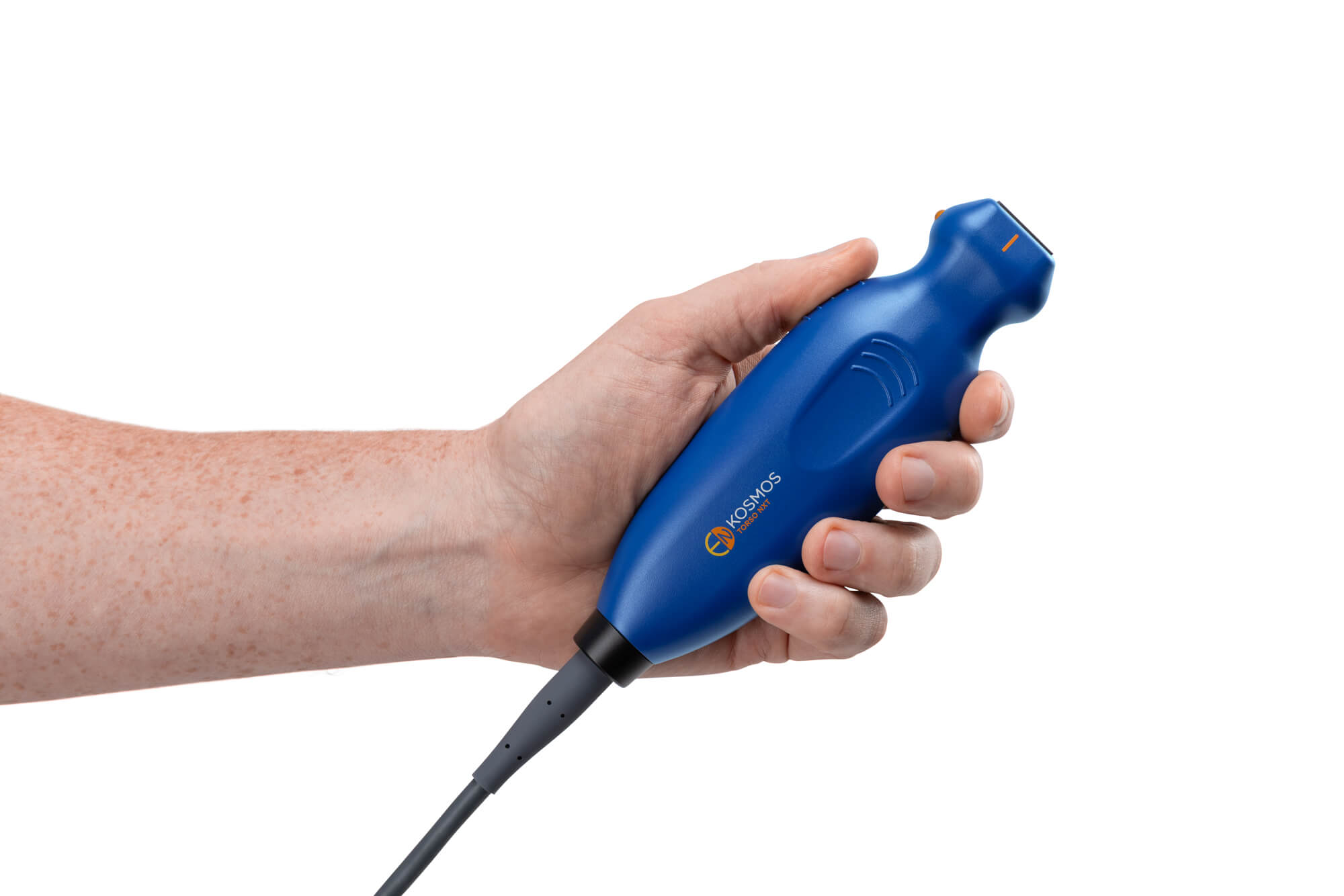
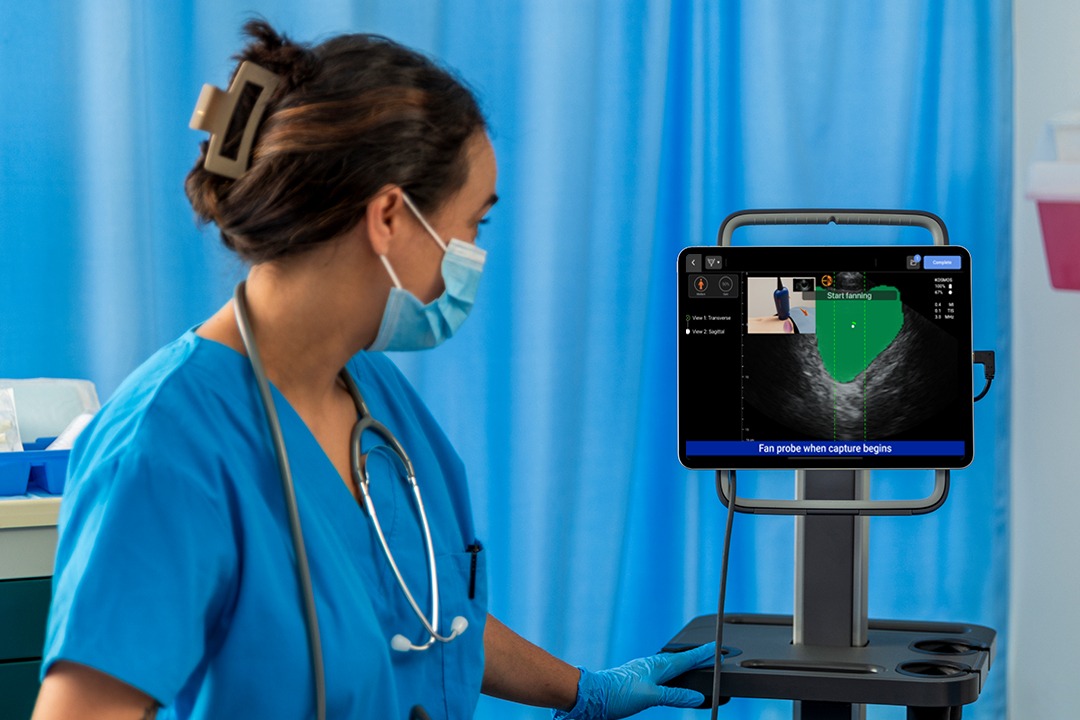
Kosmos approaches bladder scanning differently than every other device on this list. Rather than building a dedicated single-purpose scanner, EchoNous built a clinical platform that automatically places the calipers and predicts the best sagittal and transverse image “slices” to deliver bladder volume measurement. It can be configured as a stand-alone bladder scanner, or as a point-of-care ultrasound device with several capabilities. Kosmos Bladder AI offers accuracy that exceeds every dedicated scanner in this review.
In a clinical performance study, Kosmos Bladder achieved a correlation coefficient of 0.988 against manual bladder volume measurement, with ±3% accuracy across diverse patient populations.2
The solid-state PZT crystal probe has no moving parts, unlike wobbler and rotational motor probes. Preventative maintenance, other than occasional software updates provided by the Company, are not required, and the robust 5-year warranty leads in the category.
The optional expansion path is what sets Kosmos apart from every other option. Start with bladder scanning, add ultrasound-guided IV access (with the Kosmos Lexsa probe), and optionally expand into cardiac, lung, and abdominal imaging. One device, one training investment, one maintenance profile replacing up to three separate systems.
Strengths: Highest published accuracy among reviewed bladder scanners, AI-powered acquisition, solid-state durability, 5-year warranty, multi-application expandability, no subscription, scan while charging, made in the USA, SOC2 certified, supports secure workflows with HIPAA compliance.
Considerations: Requires training different from dedicated scanners. System priced higher than entry-level options (offset by lower total cost of ownership, multi-use value, and five year warranty).
2. Verathon BladderScan i10
The BladderScan i10 is the workhorse of the dedicated bladder scanner market. The i10 benefits from deep brand recognition, established service networks, and a simple onboarding process. New operators may be able to scan within minutes of receiving the device.
Accuracy is rated at ±7.5% on volumes greater than 100 mL, which is adequate for most routine bladder volume assessments.5 The 10.1-inch touchscreen provides a clear interface, and Vmode 3D imaging gives visual confirmation of the scan.
The i10’s limitations are the result of its single-purpose design: it measures bladder volume and nothing else. It uses a mechanical probe with moving parts, rather than a solid-state design. The device is contraindicated in pregnancy, fetal patients, suprapubic wounds and ascites.5 It cannot scan while connected to external power, and the warranty excludes consumables and accessory damage.5,12
Strengths: Fast onboarding, large installed base, proven reliability for bladder-only workflows, strong GPO presence.
Considerations: Bladder only, mechanical probe, ±7.5% accuracy, contraindicated in pregnancy, fetal patients, suprapubic wounds and ascites, cannot scan while connected to external power.5
3. Butterfly iQ3 (iQ+)
Butterfly has grown rapidly in the POCUS market by offering full ultrasound capability. The Bladder AI mode provides automated volume measurement, making it a viable option for teams that want multi-purpose capability on a tight budget.13
The trade-offs are meaningful. Bladder AI requires an annual subscription, which adds up over the life of the device. Accuracy is not validated above 740-741.1 mL.13,14 Battery life may be an issue, with up to 2 hours on the iQ3 or 144 minutes of scanning per charge on the iQ+.7,15 The standard warranty for probes is three years.16
Strengths: Low hardware price, full POCUS capability, strong education ecosystem.
Considerations: Subscription required for AI, short battery life, accuracy limited to <740 mL, 3-year warranty, complex charging.
4. BioCon-900 (Laborie)
The BioCon-900 is a straightforward dedicated bladder scanner with basic auto-aim functionality. It serves the market segment that needs a simple, no-frills device for routine bladder volume checks.
The primary concern is probe reliability. The BioCon uses a “wobbler” mechanical probe, which has moving parts unlike a solid-state probe. Accuracy is rated at 0–999 mL; ±15%, ±15 mL.8 Workflow automation is limited, and there is no path to additional clinical applications.
Strengths: Simple operation, basic auto-targeting.
Considerations: Wobbler probe reliability issues, no expansion, limited workflow automation, mechanical maintenance requirements.
5. Clarius Bladder AI with C3 HD3 or PA HD3 Transducers
Clarius makes a well-regarded wireless handheld ultrasound for general POCUS applications. However, its bladder measurement capability is not competitive with dedicated scanners or AI-guided platforms.
Published limits of agreement (-25.45 to +20.83 mL, widening to -91.70 to +60.50 mL) make Clarius less competitive than dedicated scanners or AI-guided platforms for primary bladder volume measurement.9 Battery life is approximately one hour, with an approximately 90 minute charge time, which may be less practical for nursing workflows that require all-shift availability.17 Wireless connectivity may provide concerns in some applications.
Strengths: Lightweight, wireless, good general POCUS image quality.
Considerations: Accuracy is lower than other devices for clinical bladder volume decisions, 1-hour battery, connectivity issues.
6. BD (Becton, Dickinson) BBS Revolution
BD’s bladder scanner uses a “rotational motor” probe with moving parts, unlike solid-state probes. Accuracy is the weakest in this comparison at ±12.5% + 12.5 mL, a combined range that could limit clinical utility for catheterization decisions.10
The device offers no POCUS expansion, no AI features, nor a competitive advantage over any other option in this guide. For facilities with existing BD scanners approaching end of life, this is an opportune time to evaluate alternatives.
Strengths: Established distribution network.
Considerations: Lowest published accuracy in class, rotational motor probe, reported FDA adverse event, no AI, no expansion.
Your Setting, Your Answer: Decision Guide by Department

If you’ve read this far, you already know more about the bladder scanner market than most buyers. But the fastest way to a decision is to start from where you work, not from a product list. Find your setting below; the recommendation follows.
Emergency Department
What matters most: Accuracy on complex patients, multi-use capability, contraindications or lack thereof, speed.
Best fit: Kosmos by EchoNous. EDs need accurate bladder volume measurement across diverse patients and may benefit from multi-application capability (bladder + vascular access + FAST exam). Kosmos’s combination of high accuracy and broad clinical capability makes it a strong fit for the ED environment.
ICU / Critical Care
What matters most: Measurement precision, complex patient populations, integration with broader clinical assessment.
Best fit: Kosmos by EchoNous. ICU patients are the most medically complex, high BMI, ascites, post-surgical, potentially hemodynamically unstable. Accuracy matters most when measurements directly inform catheterization decisions in patients at highest CAUTI risk. Kosmos’s ±3% accuracy and optional cardiac/lung imaging add significant value in critical care.
Med-Surg / General Nursing Floor
What matters most: Ease of use across many operators, fast onboarding, device availability.
Best fit: Verathon BladderScan i10 or Kosmos by EchoNous. This is the setting where the choice is most genuinely dependent on your team. If nursing staff have minimal ultrasound experience, high turnover, and no plans to expand into other imaging, Verathon’s simplicity may be preferred. If the floor is building any POCUS capability, or if you also need vascular access, Kosmos may offer better long-term value.
Skilled Nursing Facility (SNF) / Long-Term Care
What matters most: Budget, simplicity, minimal IT requirements, low maintenance.
Best fit: Kosmos Bladder or Verathon BladderScan i10. SNFs generally face tight budgets and lean staffing. On the one hand, the Verathon i10 offers a competitive upfront cost and fast onboarding. On the other hand, Kosmos’s maintenance-free solid-state probe, 5-year full warranty, and AI guidance for lean nursing teams make a compelling total-cost-of-ownership case, especially for facilities that also need vascular access capability.
Ambulatory / Outpatient Clinics
What matters most: Portability, speed, focused clinical need, cost efficiency.
Best fit: Depends on scope. If bladder volume is the only use case, Verathon i10 keeps things simple. If the clinic also performs vascular access, basic cardiac screening, or other ultrasound procedures, Kosmos consolidates those into one portable device offering a better solution.
Buyer Checklist
- Use these questions to guide your evaluation process:
- What clinical applications do we need today? What will we need in 3 years?
- What is our accuracy threshold for catheterization decisions, and does each device meet it?
- Do we treat patient populations (pregnancy, ascites, pediatric) where some devices have contraindications?
- How many single-purpose devices could we consolidate into one multi-application platform?
- What is the 5-year total cost of ownership, including maintenance, probe replacement, warranty, and subscriptions?
- How much training time can we invest, and what capability does that training unlock?
- Does the device scan while charging? (Critical for shift-long availability.)
- How long is the warranty, and what does it exclude?
- Is the device manufactured and serviced in the United States?
- Is the platform HIPAA and SOC2 compliant?
Scoring Summary (1–5 Scale)
The following table summarizes our evaluation across the six key criteria. Scores reflect overall clinical value in each dimension, with 5 being the strongest.
Scoring rubric: 5 = best-in-class, supported by published peer-reviewed or clinical-validation data; 4 = strong, supported by published manufacturer specifications and clinical-use experience; 3 = adequate for routine use, meeting category baseline; 2 = below category baseline on this dimension; 1 = significant limitation that materially affects clinical use. Scores are an editorial composite based on the published evidence cited in the device reviews above; the rubric is intended to support and not replace direct review of each device’s IFU and validation data.
Figure 2a: Scoring Summary
| Device | Accuracy | Ease of Use | Training |
|---|---|---|---|
EchoNous Kosmos | 5 | 4 | 4 |
Verathon i10 | 3 | 5 | 5 |
BioCon-900 | 3 | 4 | 5 |
Butterfly iQ3 | 3 | 3 | 3 |
BD | 1 | 4 | 5 |
Clarius | 1 | 2 | 2 |
Figure 2b: Scoring Summary
| Device | Portability | AI Features | TOTAL |
|---|---|---|---|
EchoNous Kosmos | 4 | 5 | 22/25 |
Verathon i10 | 3 | 3 | 19/25 |
BioCon-900 | 3 | 2 | 17/25 |
Butterfly iQ3 | 4 | 3 | 16/25 |
BD | 3 | 1 | 14/25 |
Clarius | 3 | 5 | 13/25 |
Frequently Asked Questions
Kosmos Bladder by EchoNous has the highest published accuracy at ±3% (correlation coefficient 0.988 in a prospective, clinical validation study), validated across diverse patient populations.
Verathon BladderScan i10 may require the least training with the claim of minutes to basic competency.
Butterfly iQ requires a subscription for AI features including Bladder AI mode. Kosmos by EchoNous and Verathon do not charge subscription fees.
For pure simplicity: BladderScan i10. For best long-term value: Kosmos Bladder (no maintenance, 5-year warranty, confidence in accuracy for small teams, optional vascular access add-on).
The ED requires accuracy across complex patient populations, multi-use capability (bladder + vascular access + FAST), and a device with no contraindications. Kosmos by EchoNous is the only option that meets all three requirements.
References
- Centers for Disease Control and Prevention. Guideline for Prevention of Catheter-Associated Urinary Tract Infections. Atlanta, GA: CDC; 2009. Updated 2017. https://www.cdc.gov/infection-control/hcp/cauti/. Accessed June 2026.
- EchoNous Inc. Kosmos Bladder AI Clinical Performance and Non-Clinical Testing. Document D012406, Rev A. Redmond, WA: EchoNous Inc. Prospective study; 146 participants, 2 sonographers, 4 nurses. Correlation coefficient = 0.988 (95% CI: 0.986–0.99), p < 0.0001. Published at https://echonous.com/wp-content/uploads/2026/03/D012406_Rev-A_Kosmos-Bladder-AI-Clinical-Performance-and-Non-Clinical-Testing-1.pdf. Accessed June 2026.
- EchoNous Inc. Kosmos Bladder AI Volume Accuracy. Document D012472, Rev A. Redmond, WA: EchoNous Inc. Phantom validation study using industrial CT scanning by Delphi Precision Imaging; 3 participants, 4 phantoms (10–600 mL), 30 measurements per phantom. Accuracy: ±3 mL (<100 mL) and ±3% (100–600 mL). Published at https://echonous.com/wp-content/uploads/2026/03/D012472_Rev-A_Kosmos-Bladder-Volume-Accuracy_Clean-1.pdf. Accessed June 2026.
- EchoNous Inc. Kosmos product specifications, warranty terms, and compliance documentation. Published at https://echonous.com. Accessed June 2026.
- Verathon Inc. BladderScan i10 Operations and Maintenance Manual; BladderScan Product Comparison. Published at https://www.verathon.com/service-and-support/bladderscan-i10. Accessed June 2026. FDA 510(k) clearance on file.
- POCUS Butterfly iQ+ – disappointing support. Reddit. February 9, 2024. Accessed June 2026. https://www.reddit.com/r/medicine/comments/1amol8m/pocus_butterfly_iq_disappointing_support/
- Butterfly Network, Inc. iQ3 product specifications and subscription pricing. Accessed June 2026. Specifications: https://www.butterflynetwork.com/iq3-specs. Pricing: https://www.butterflynetwork.com/pricing.
- Medline Industries, LP. BioCon 900 Ultrasonic Bladder Scanner [product brochure]. Document LIT178R. Northfield, IL: Medline Industries, LP. Accessed June 2026. https://www.medline.com/media/catalog/Docs/MKT/LIT178R_BRO_BioCon%20900%20Bladder%20Scann.pdf
- Clarius Mobile Health Corp. Clarius Ultrasound Scanner HD3 Scanners User Manual. Rev 24. Clarius Mobile Health Corp; 2025. Accessed June 2026. https://support.clarius.com/s/article/HD3UserManuals68189af407e4c?language=en_US
- BD (Becton, Dickinson). BBS Revolution Bladder Scanner Operator’s Manual, Document PF10764. Specifications (p. 13): bladder volume range 0–999 mL; accuracy on tissue phantom ± (12.5% + 12.5 mL). FDA 510(k) K142329. Accessed June 2026. https://static.bd.com/assets/product/Documents/Urology%20and%20Critical%20Care%20(UCC)/PF10764_ud-revolution-ops-manual.pdf
- US Food and Drug Administration. MAUDE Adverse Event Report, MDR Report Key 24277861. Event date January 20, 2026. Reported February 6, 2026. Accessed June 2026. https://www.accessdata.fda.gov/scripts/cdrh/cfdocs/cfmaude/detail.cfm?mdrfoi__id=24277861
- Verathon Inc. Limited warranty: BladderScan i10™ (Document No. HQ-LD-0029/Rev-00). Verathon Inc.; 2021. Accessed June 2026. https://www.verathon.com/sites/default/files/2021-12/HQ-LD-0029_BladderScan_i10-Limited_Warranty.pdf
- Girard E, Sankaranarayanan S, Cline K, Elterman L, Greenwood B. Butterfly iQ+ Auto Bladder Volume: development and validation of a deep learning algorithm for calculating bladder volume (Document No. 980-20085-00 Rev B). Butterfly Network, Inc.; 2021. Accessed June 2026. https://assets-global.website-files.com/5a0d71308174eb0001b3572d/61e0213b0876b00c6f10f1d1_2021-11_BladderWhitepaper_RevB.pdf
- Butterfly Network. The Butterfly iQ+ Bladder Scanner. Butterfly Network, Inc. Accessed June 2026. https://www.butterflynetwork.com/bladder-scanner
- Butterfly Network. System specifications. Butterfly Network Support Portal. Accessed June 2026. https://support.butterflynetwork.com/s/article/16910421132187-System-Specifications?language=en_US
- Butterfly Network. Product offerings. Butterfly Network Support Portal. Accessed June 2026. https://support.butterflynetwork.com/s/article/43330292936603-Product-Offerings?language=en_US
- Clarius Mobile Health. Clarius HD3 Scanners Technical Specifications. Document MKTG-00153, Rev 6. Clarius Mobile Health; October 2023. Accessed June 2026. https://www.performancehealth.com/amfile/file/download/file/5962/product/146972/