
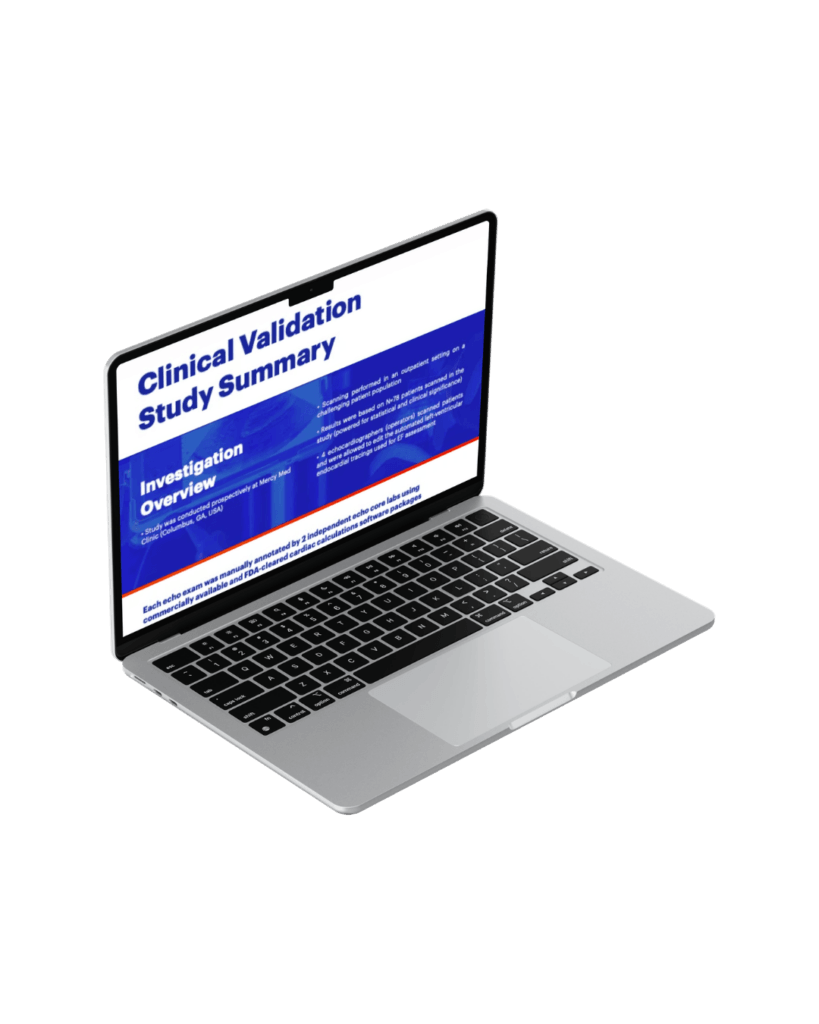
Evaluating AI-Assisted Ejection Fraction? Start with the Clinical Validation Data
See how Kosmos AI EF performed against expert-read, gold-standard EF measurements in a prospective study of 78 patients, independently adjudicated by echocardiography labs at Massachusetts General Hospital and UCSF.
Built on Prospective Research
Before AI-assisted EF earns a place in the clinical workflow, it has to hold up against expert review, not just a spec sheet. Here is what the validation is built on:
- Real clinical setting. Conducted prospectively at Mercy Med Clinic (Columbus, GA)
- Real-world difficulty. A challenging outpatient population, not a curated set of easy studies
- Clinician in the loop. Four echocardiographers scanned patients and could review and adjust the automated left-ventricular tracings, reflecting how clinicians actually use the tool
- Blinded, independent adjudication. Two independent echo core labs at Massachusetts General Hospital and UCSF manually annotated every exam using commercially available, FDA-cleared cardiac calculation software, with no access to the Kosmos AI EF results
Beyond the Spec Sheet: Does AI EF Hold Up to Expert Review?
Ejection fraction drives real clinical decisions, so an AI-assisted estimate has to earn clinician trust with evidence, not marketing claims. Before adopting AI EF, most clinical and procurement teams want the answer to a few direct questions:
- How closely does Kosmos AI EF track expert-read, gold-standard EF?
- Does letting a clinician review and adjust the automated tracing improve agreement, or is the raw AI output the ceiling?
- Does performance hold on a real, unselected outpatient population, not just an idealized dataset?
This study was designed to answer those questions with prospective, blinded, independently adjudicated data.
Enter your info to get the study!
Key Findings?
Kosmos AI EF was compared against a gold-standard EF, the average of the two echo core labs’ expert reads, under two conditions:

the AI output

AI output after clinician review and adjustment
Validated Under Real Clinical Conditions
The study was designed to reflect how AI EF is actually used at the point of care, not an idealized lab setting:
- Prospective design, run in an outpatient clinical setting
- A challenging patient population, not pre-selected easy studies
- Four different operators, reflecting real operator-to-operator variability
- Independent, blinded adjudication by two academic echo core labs with no access to Kosmos results
- Statistical design and methodology overseen by a professional biostatistician
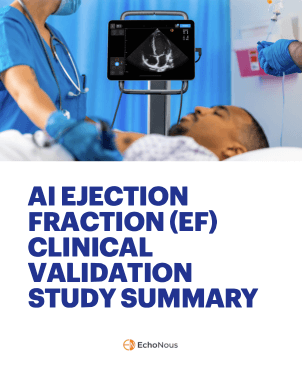
Get the AI EF Clinical Validation Study
See the full methodology, patient population, and data behind Kosmos AI EF’s agreement with expert-read gold-standard measurements.
Talk to our team
(844) 854-0800
|
www.echonous.com